
News Summary
As the popularity of electric bicycles (e-bikes) grows in Beaufort County, riders must be aware of local regulations to ensure safety and compliance. E-bikes are categorized into three classes, each with specific rules regarding motor power and speed. Class 1 and Class 2 e-bikes are generally permitted on public pathways, while Class 3 has restrictions. Compliance with regulations, including speed limits and labeling, is crucial for e-bike riders to enjoy safe and responsible use in the area.
Beaufort, SC – Electric bicycles, commonly referred to as e-bikes, have become an increasingly popular mode of transportation and recreation in Beaufort County, South Carolina. As the use of e-bikes continues to rise, understanding the local regulations is essential for riders to ensure safety and compliance.
E-bikes in South Carolina are classified into three distinct classes based on their motor power and maximum assisted speeds. The classifications are as follows: Class 1 e-bikes provide pedal assistance only and have a maximum assisted speed of 20 mph; Class 2 e-bikes can be throttle-assisted and/or pedal-assisted, with the same maximum speed of 20 mph; and Class 3 e-bikes also offer pedal assistance, reaching up to 28 mph, but stop providing assistance once this speed is reached. Notably, Class 2 e-bikes feature throttle functions akin to those found on motorcycles.
According to South Carolina legislation, e-bikes are categorized as “vehicles” and must adhere to the same road rules as conventional bicycles. This means they are governed by regulations that ensure riders maintain a safe and responsible riding environment. Additionally, e-bikes must not exceed a motor power of 750 watts (equivalent to 1 horsepower); exceeding this limit reclassifies the e-bike as a moped, which involves different regulations.
For riders, it is important to note that e-bikes must cease motor assistance when the rider stops pedaling or applies brakes. Each e-bike is required to have a permanent label demonstrating its wattage capability and maximum assisted speed. Any modification of the e-bike’s speed setting necessitates a replacement of the wattage or horsepower label, which could violate local regulations. All e-bikes must comply with the Federal Consumer Product Safety Code to ensure safety standards are met.
While South Carolina has no law mandating helmet use for cyclists, the Consumer Product Safety Commission recommends wearing helmets for enhanced safety. E-bikes with a power output of 750 watts or less do not require licensing or registration; however, those exceeding this threshold do need to be licensed and registered with the appropriate authorities.
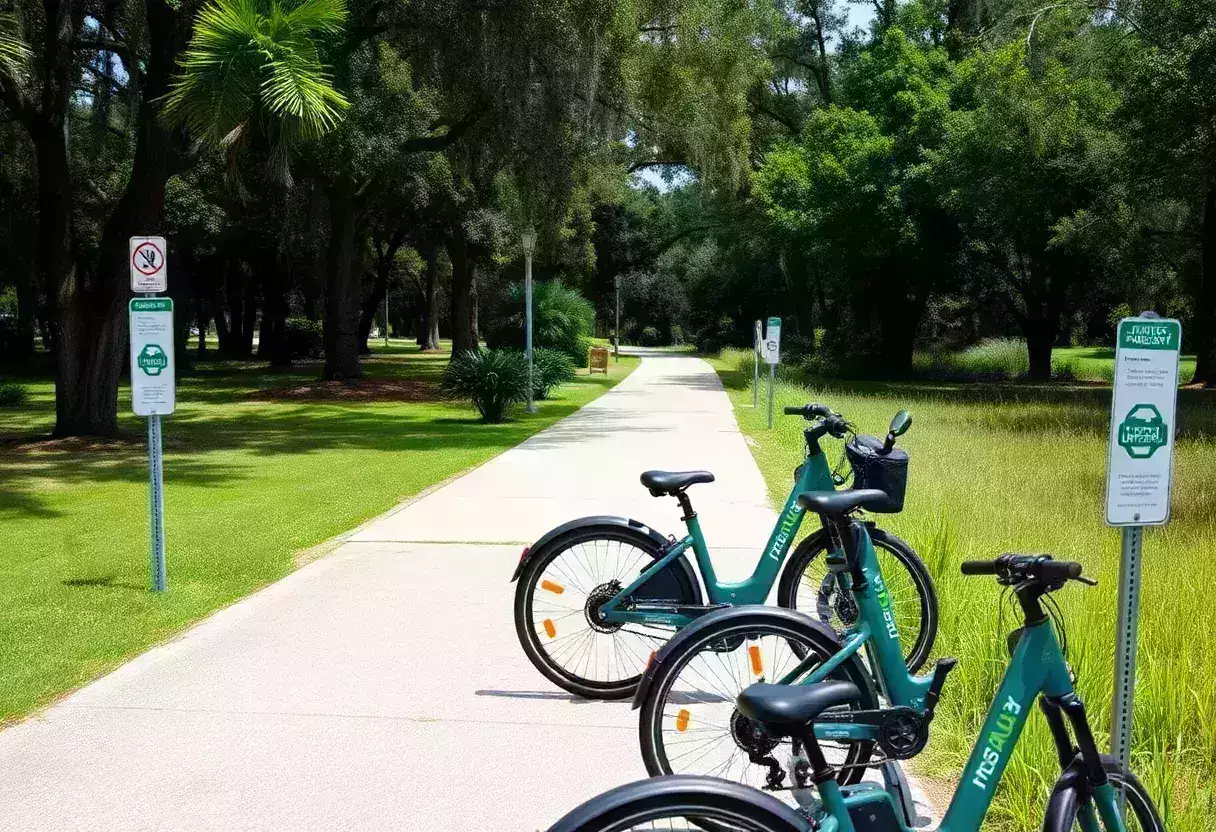
Beaufort County has specific regulations for the use of e-bikes on public pathways. For example, on the Spanish Moss Trail, only Class 1 e-bikes are allowed, restricting other classes to ensure safety on the trail. Riders must maintain a safe speed and signal when passing others. In contrast, Hilton Head Island Pathways permit Class 1 and Class 2 e-bikes, but Class 3 e-bikes are banned. Furthermore, any e-bikes utilizing these pathways must visibly display their wattage and speed labels, and rental businesses are required to provide safety pamphlets for users.
In addition to pathways, regulations state that all but mountain bikes are permitted on the beach, and Class 3 e-bikes are forbidden from bike paths and sidewalks. Notably, while South Carolina State Parks currently do not have specific policies addressing e-bikes, riders are encouraged to verify the rules at individual locations before embarking on their journeys. Conversely, all classes of e-bikes may be utilized on motorized trails and roads in national forests and grasslands, as per U.S. Forest Service regulations.
It is imperative for e-bike riders to adhere to standard road rules when navigating public roads. The growing popularity of e-bikes in Beaufort County reflects a broader trend towards sustainable and enjoyable transportation methods, but ensuring compliance with local laws is crucial for the safety and well-being of all road users.
Deeper Dive: News & Info About This Topic
HERE Resources
Additional Resources
- Island Packet: Local News
- Wikipedia: Electric Bicycle
- Post and Courier: Bluffton Bike Crash
- Google Search: Beaufort County E-Bikes
- WJCL: Bicyclist Killed
- Encyclopedia Britannica: Bicycle
- Post and Courier: Cyclist Killed in Bluffton
- Google News: Bluffton Bicyclist