As the 2026 hunting season approaches, new participants in Beaufort and the surrounding Lowcountry region are advised to consult a comprehensive guide detailing essential preparation steps. The guide, aimed at ensuring responsible and safe hunting practices, emphasizes the critical importance of education, proper licensing, and adherence to state-specific regulations before heading into the field.
A foundational requirement for any new hunter is the completion of a state-approved hunter education course. These programs are designed to instill critical knowledge and skills, covering topics such as firearm or archery safety, principles of fair chase, accurate wildlife identification, establishment of safe zones of fire, basic survival techniques, first aid, and specific local regulations. Courses are typically offered in various formats, including traditional classroom instruction complemented by a field day, online coursework followed by an in-person field day, or, for adults in some states, fully online instruction. For those in Beaufort County, understanding the South Carolina Department of Natural Resources (SCDNR) requirements for these courses is paramount, ensuring compliance with state law.
Navigating the complex landscape of hunting licenses, season dates, and specific regulations is another critical step. These requirements are not uniform; they vary significantly by state, specific game unit, species, and even the type of weapon used. Factors such as minimum calibers or draw weights, bag limits, and tagging or reporting requirements can also differ based on the animal’s sex or age. High-demand hunts, particularly for popular game species, may necessitate lottery applications, while other tags might be readily available over the counter. Hunters in the Beaufort area must familiarize themselves with South Carolina’s specific regulations, which govern access to public lands like parts of the ACE Basin National Wildlife Refuge or Hunting Island State Park, where specific hunting seasons and rules apply. Obtaining the correct hunting license and species tags, along with securing legal hunting access, must be completed well in advance of opening day.
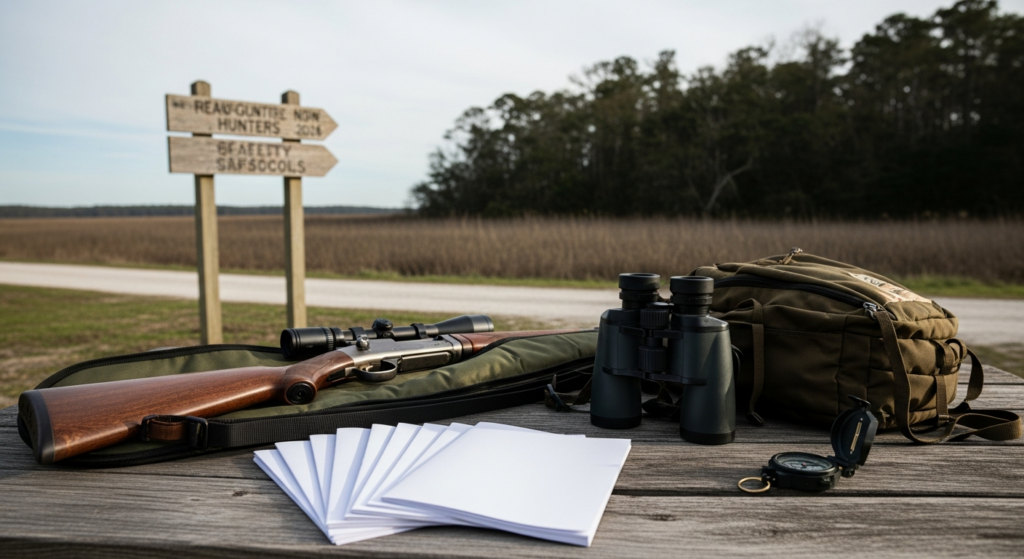
Equipping oneself properly is vital for both safety and success. The guide recommends a basic kit that includes a legal weapon—be it a rifle, shotgun, or compound bow—along with appropriate ammunition or arrows. Practice equipment is also crucial for proficiency. Beyond the weapon, essential items include all necessary licenses and tags, hunter orange clothing where required for visibility, and broken-in waterproof boots. Layered, non-cotton clothing is advised to manage temperature fluctuations. Other critical items for a day pack include binoculars for scouting, sufficient water, high-calorie snacks, a headlamp with extra batteries, a sharp knife, and a comprehensive first-aid kit. The initial investment in new gear can be substantial, with entry-level rifles and basic scopes estimated to cost between $450 and $800. A deer- or small-game shotgun typically ranges from $350 to $700, while a compound bow package can be $400 to $900. Basic clothing layers and boots might cost $200 to $400, and entry-level binoculars between $100 and $250.
Safety remains the paramount concern for all hunters. The guide reiterates four fundamental firearm safety rules: always treat every firearm as if it were loaded, keep the muzzle pointed in a safe direction at all times, keep the trigger finger off the trigger until the moment of shooting, and always positively identify the target and be aware of what is in front of and beyond it. For those utilizing elevated hunting positions, such as tree stands, additional safety measures are non-negotiable. These include wearing a full-body safety harness, using a lineman’s belt for climbing, employing a lifeline for continuous attachment, thoroughly inspecting the stand before each use, and utilizing a haul line to raise and lower unloaded weapons.
After a shot is taken, responsible hunting practices dictate a specific sequence of actions. Hunters are advised to carefully observe the animal’s reaction and precisely mark the last known location. Depending on the situation, waiting for an appropriate period before tracking can be beneficial. Tracking should commence at the hit site, proceeding slowly and methodically by following signs such as blood trails or disturbed vegetation. If tracking becomes difficult or the animal cannot be located, seeking help from experienced trackers is recommended. Once the animal is recovered, it must be tagged as required by state regulations. Prompt cooling and cleaning of the meat are essential for preservation, and all state rules regarding carcass or quarter transport must be strictly followed. These steps ensure ethical recovery and proper handling of game.
Why it matters in Beaufort
For residents of Beaufort and the surrounding Lowcountry, the responsible preparation for hunting season is not merely a matter of personal recreation but a component of regional wildlife management and safety. With significant natural areas like the ACE Basin National Wildlife Refuge and Hunting Island State Park nearby, understanding and adhering to state regulations directly impacts the health of local ecosystems and the safety of all who enjoy the outdoors. The Beaufort County Government, through its support of conservation efforts and public safety initiatives, underscores the importance of educated and ethical hunting practices. Ensuring that new hunters are well-versed in safety protocols and local laws helps maintain the balance of wildlife populations and prevents accidents, contributing to the overall well-being of the community and preserving the Lowcountry’s natural heritage for future generations.